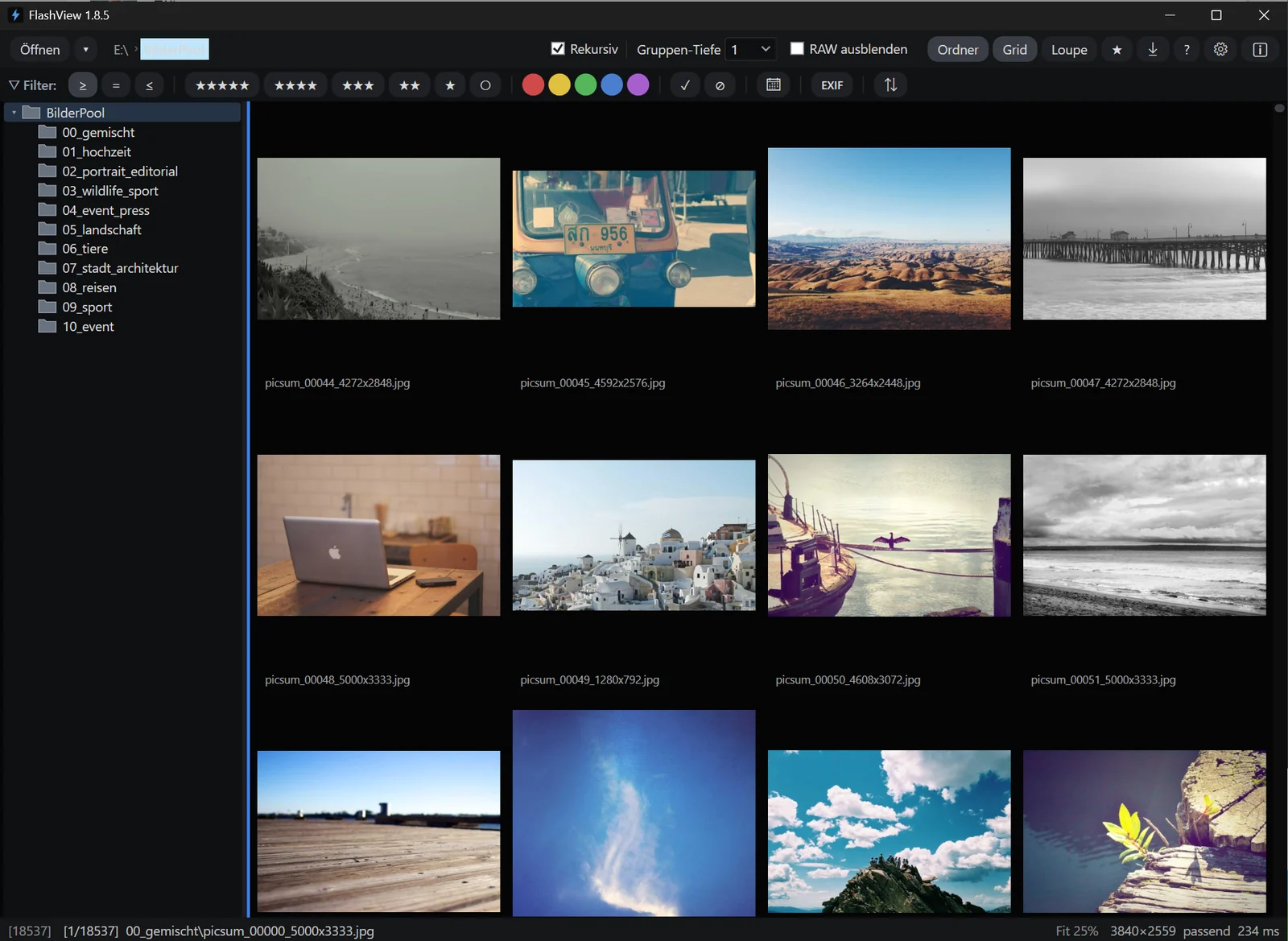
It's just past midnight, and all you meant to do was tidy up. An external SSD has been sitting on your desk for weeks, a flat black slab with a single folder on it that you named, without much love, „PHOTOS_all". Twelve years live in there. You drop it onto FlashView, more out of guilt than curiosity – and then the thing you didn't expect happens: nothing stutters. No catalog thinking for minutes, no spinning hourglass. The first image is simply there, big and sharp. You press the arrow key, and the archive begins to stream past you. Thirty seconds in, you've forgotten about tidying up. You're not travelling through a folder anymore – you're travelling through your life.
Eighty thousand images sit on this SSD, maybe more. For years you treated them like a burden: something you back up, move, copy twice and never look at again. Tonight, for the first time in ages, it hits you – this isn't data clutter. It's all still here.
The folder you never open
Every photographer has a drive like this. Two, three terabytes, grown over a decade, with folder names only you can decode: „2013_Summer", „Client_Reha_final_final", „Mountains_new". It's the memory of your work, and it's precisely this memory that you never open.
The reason is mundane and yet decisive: looking costs too much. The Lightroom catalog would have to import for an hour before you see the first frame. Windows Explorer builds its previews so sluggishly that you end up staring at grey boxes as you scroll. So you don't. The memories sit in the dark, a backup you pay for and never visit. Until a viewer is fast enough that looking costs nothing. Then something tips.
Just scroll – and suddenly you're back there
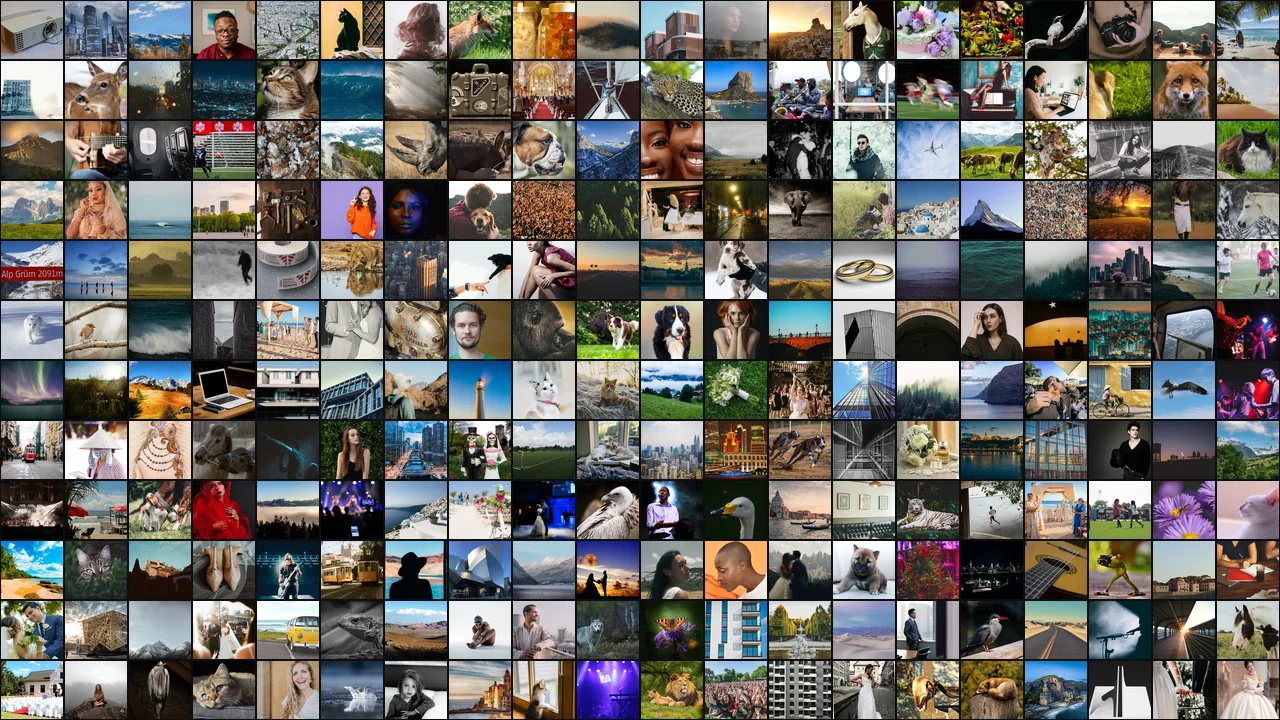
You don't open a subfolder, you open the root, recursively, all of it at once. And then you do the simplest thing there is: you hold down the arrow key and watch twelve years stream past. No import, no waiting – FlashView shows the JPEG embedded in every RAW, and that's why it flies (why that changes everything). And as it flies, the archive catches you, one frame at a time.
There's the studio day when it all came together. The model whose name you'd nearly forgotten turns into the light, and there's that one look again, the moment you both knew at once: this is it. Two frames on, an abandoned factory, afternoon light through the broken windows; you'd snuck in and had half the location to yourselves. Then a sunrise you only ever saw like that once, on a pass whose name you remember again, because you were there.
You scroll on, and the pictures turn personal. Old friends, younger, lighter. A wedding where someone is dancing who is no longer around. A party, half out of focus, ISO far too high – and you keep it anyway, because the night was worth it. An event, endless rows of handshakes, and in the middle of it the one honest laugh. A concert: the singer in the spotlight, haze, backlight, sweat, a frame where everything lines up. And finally the client who nearly drove you to despair back then – today all you see is that the pictures turned out good, and you grin.
At some point you lean back, and there it is, the feeling that had slipped away between deadlines and hard drives: overview. „I made all of this." Not three portfolio highlights, but the whole body of work, a life in pictures, and it's more than you thought.
One keystroke, and you find it again
Mid-scroll you stumble over a gem you'd completely forgotten. Too good to let it vanish into the dark a second time. So you press a key: a star, a color, a pick. That's it – the mark goes straight into the file as standard XMP, no catalog, no database that forgets it later.
And because it lives in the file, you can find that image again whenever you like: filter for that mark once, and across twelve years exactly this selection surfaces. That's how a thread through your archive quietly forms – a „best of", a set „for the new website", a stack „I really need to print these" – without ever importing a thing.
 Short · YouTube
Red is not a star
Watch video →
Short · YouTube
Red is not a star
Watch video →
What the archive knows about you
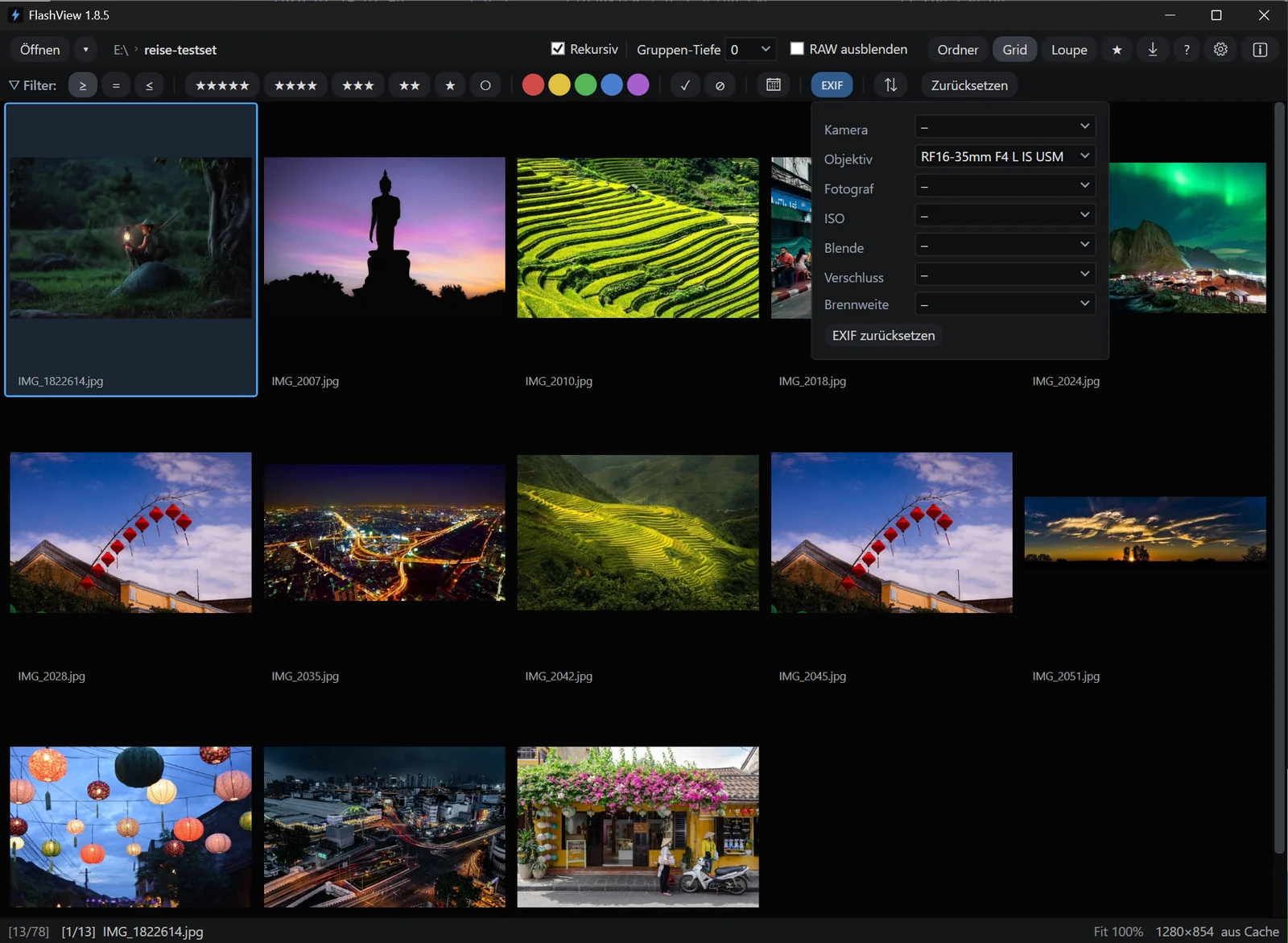
Then you flip a small switch in the settings, „EXIF sort & filter", and the archive starts answering questions you never asked out loud.
Which focal length do you really use? Not the one you believe is your style – the real one. You go through the whole archive focal length by focal length, one filter, a glance at the hit count, the next. And maybe there it is in black and white: you've thought of yourself as a wide-angle shooter, while in truth the 85 has been doing half the work for years. The archive doesn't lie.
It knows more. Filter by ISO and you watch your nerve for available light grow over the years. Filter by camera and your whole gear history unrolls: the body you eventually retired, and the one your best years were shot on. The shoebox of pictures turns into a mirror – and you make your next lens decision not from your gut, but knowing what you actually need.
Finding things again, without keeping a catalog
The genuinely magical part: none of this needs an import or a database, and yet the whole archive is queryable. „Where was the Müller wedding again?" – Ctrl+F, type the folder name, and you're there. „Show me the summer of 2019" – date filter, done. Local, instant, even across a hundred thousand images.
Catalog programs turn it around: you maintain a database so it will lend you back your own archive. Here the folder is the database, and every file carries its own truth – rating, color, camera data. The compute for it is sitting on your desk anyway; it's just finally being used.
A place you can visit
In the end that's the real change. Your archive is no longer a burden, no longer a backup you never open, no longer a guilty conscience in the shape of a flat black slab. It's become a place you can visit – for the memory, for the overview, for the honest answer to the question of how you actually shoot.
It's two in the morning, the screen is still glowing, and you haven't tidied a single image. But you've seen half your life again, flagged a dozen gems, and learned along the way that you're an 85 person after all. All of it a single scroll away. Local, fast, yours.
If you'd like to try FlashView for it, you'll find it at flashview.net.